
Custom AI vs. Off-the-Shelf
The Build-Buy-Partner Decision
March 17, 2026
Somewhere inside most enterprises right now, two conversations are happening in parallel. In one room, an internal team is three months into a prototype — confident that a proprietary model will deliver something competitors cannot replicate. In another room, a vendor is halfway through a demo of an off-the-shelf platform that handles the same use case, costs a fraction of the build, and can go live next quarter. Both rooms are asking the wrong question.
01 - The Problem
The Problem With "Should We Build?"
The question arrives under pressure. A competitor announces it has built a proprietary AI model for customer underwriting, or supply chain optimization, or clinical diagnosis. An internal data science team demonstrates a proof of concept that seems promising. A vendor arrives with a polished platform and a client list. The question “should we build our own?” gets inserted into the agenda before a more fundamental question has been answered: what kind of advantage are we actually trying to create, and which model of AI ownership protects it?
This sequencing problem is not a failure of analysis. It is a failure of frame. Organizations default to “build or buy?” because it feels like a tractable decision — it has a clear set of options, a procurement process to follow, and a budget to attach to it. The prior question — about competitive positioning, organizational capability, and the long-term structure of AI dependencies — is harder to formalize, so it tends to happen informally, or not at all.
The result is predictable. Organizations end up with either a proprietary model that cost significantly more than estimated and delivers considerably less than projected, or a portfolio of SaaS integrations that handles every function adequately and differentiates on none. Neither outcome is inevitable. Both are the product of treating a competitive strategy question as a procurement decision.
02 - The Wrong Question
Why Build vs. Buy Is the Wrong Frame
The binary is false in practice, and it misleads in principle. In practice, organizations are not choosing between two options — they are managing a portfolio of AI capabilities, each with different characteristics, different maturity levels, and different relationships to competitive advantage. Some of those capabilities should be built. Some should be bought. Some should be accessed through deep integration partnerships. And some should be deferred entirely until the market matures and the cost of entry drops to a level where the return justifies it.
The real question is not “build or buy?” but something more precise: what ownership model maximizes our AI advantage for each capability, given our competitive position and our organizational readiness to sustain that choice? That question does not have a single answer. It has a portfolio answer — a map of which capabilities belong in which ownership model, and how that map should shift as both the competitive landscape and the organization’s own capabilities evolve.
Three failure modes emerge consistently when organizations skip this framing and go straight to the binary:
The Capability Trap:
Building AI capabilities that are genuinely commodity functions, which a well-configured SaaS platform handles adequately at a fraction of the cost. Organizations fall into this trap when they treat proprietary development as inherently more strategic than integration, regardless of what is actually being built. The result is significant engineering investment in capabilities that create no differentiation because the same function is available to every competitor at scale.
The Dependency Trap:
Buying AI capabilities that sit at the core of competitive advantage, creating deep integration dependencies on vendor platforms for functions the organization should own. This trap is particularly dangerous because it tends to feel rational at the point of decision — the vendor platform works, the timeline is faster, the cost is lower. The cost becomes visible later, when the organization wants to differentiate on a function it has effectively outsourced.
The Readiness Illusion:
Choosing to build before the organizational infrastructure exists to sustain proprietary development. Readiness is not headcount or budget. It is the quality of data pipelines, the density and retention of ML talent, the maturity of model governance processes, and the leadership capacity to sustain a multi-year investment cycle without demanding results on a quarterly timeline. Most organizations that fall into this trap have the first two and lack the last two.
The question is not which option is better. It is what kind of advantage you are trying to create — and whether your ownership decisions are protecting it or eroding it.
03 - The Diagnostic
What the Decision Actually Depends On
Before the framework, the three dimensions that determine the right ownership model deserve direct examination — not as abstract variables, but as things that look different in practice than they do in planning documents.
Competitive Proximity: Core, Enabling, and Context
The most important diagnostic question is also the one most frequently skipped: where does this AI capability sit relative to what the organization actually competes on? The answer divides into three zones.
A Core capability is one where the AI is the differentiator — where proprietary performance on this function constitutes the product, the service, or the primary source of competitive advantage. A logistics firm’s route optimization model, a fintech’s credit risk engine, a diagnostics company’s imaging interpretation pipeline — these are not AI applications supporting the business. They are the business, or close enough to it that the distinction collapses. Ownership of these capabilities is a strategic imperative, not a build-vs-buy question.
An Enabling capability is one where AI amplifies an existing differentiator without being the differentiator itself. A retailer whose advantage lies in curation and buyer relationships may deploy AI in personalization — not because personalization is its competitive edge, but because AI-powered personalization compounds the advantage it already has. The ownership calculus here is more nuanced: the capability warrants significant investment, but the form of that investment depends heavily on organizational readiness and the maturity of available solutions.
A Context capability handles functions that are necessary but commodity — internal knowledge retrieval, HR process automation, code generation for standard development tasks. The firm needs these functions performed well; it does not need to own them exclusively. The strategic error is over-investing in Context capabilities at the expense of Core ones.
The same capability lands in different zones for different organizations. Natural language processing for customer interactions is a Core capability for a company whose entire value proposition is conversational AI. It is an Enabling capability for a bank that uses it to improve service quality while competing primarily on trust and product design. It is a Context capability for a manufacturer that deploys it for internal helpdesk functions. The technology is the same. The zone — and therefore the ownership prescription — is entirely different.
Organizational Readiness: What It Actually Requires
Readiness for proprietary AI development is routinely overestimated, usually on the dimensions that are easiest to measure. Organizations count data scientists and compute budgets. They should be auditing data infrastructure quality, talent retention rates, governance maturity, and — most critically — whether leadership has the capacity to sustain a three-to-five-year investment cycle without flinching at early-stage underperformance.
The most common gaps are not where organizations expect them. Data infrastructure is frequently adequate in volume but inadequate in structure — large datasets that have not been cleaned, labeled, or organized in ways that support model training at the required level of specificity. Governance is often present on paper and absent in practice — model risk frameworks that exist as policy documents but lack the operational processes to make decisions at pace. And leadership commitment is often sincere at the point of decision and fragile under the sustained uncertainty that characterizes genuine proprietary development.
The honest readiness question is not “can we start a build?” but “can we sustain it through the period where it does not yet work as well as the SaaS alternative?”
Lock-in and Optionality: The Structural Underestimate
Both build and buy decisions are systematically mispriced on switching cost, but in opposite directions.
SaaS integrations are structurally underestimated on lock-in. The nominal switching cost — terminate the contract, migrate the data — is far lower than the actual switching cost, which includes workflow entrenchment across hundreds of users, the loss of institutional knowledge embedded in the platform’s configuration, and the data gravity that accumulates as more of the organization’s decision-making becomes dependent on vendor-managed models. Organizations tend to evaluate SaaS switching cost at contract signature and discover the real cost when they try to leave.
Proprietary builds are structurally overestimated on strategic flexibility. The assumption is that owning the model means controlling the capability. In practice, proprietary models create their own lock-in — to specific talent who understand the architecture, to infrastructure investments that are hard to unwind, and to the organizational narrative that justifies the investment. Organizations discover this when the model underperforms and the cost of abandoning it appears, retrospectively, in the same column as the cost of continuing.
04 - The Apex Framework
The AI Advantage Architecture
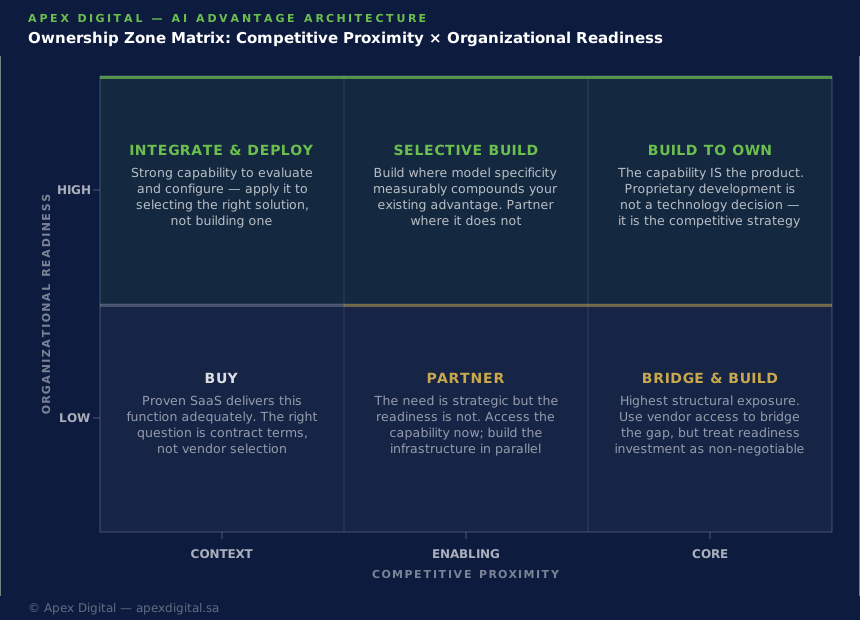
The AI Advantage Architecture integrates the three diagnostic dimensions into a structured decision tool. Its primary axes — Competitive Proximity and Organizational Readiness — establish the ownership zone for any given AI capability. The Lock-in dimension operates as a modifier, adjusting the prescription based on the switching cost topology of each decision.
The matrix below maps the resulting ownership zones. The zones are intentionally unequal in weight: Build-to-Own is the most demanding prescription, and the framework deliberately narrows the conditions under which it applies.
What Each Zone Means in Practice
Integrate & Deploy (Context × High Readiness) is a position that organizations consistently misread. High readiness creates internal pressure to build — the team has the capability, the infrastructure exists, and proprietary development feels like the obvious use of that investment. The discipline here is precisely the opposite: deploy your readiness to make better integration decisions, not to build capabilities that the market already provides at scale. The value of strong AI competency in this zone is in configuration depth, vendor evaluation rigor, and the ability to extract performance from platforms that less capable organizations leave underutilized.
Selective Build (Enabling × High Readiness) is where the build-versus-partner question is genuinely difficult and deserves genuine analysis. The capability amplifies competitive advantage without being the source of it, which means proprietary development is sometimes correct and sometimes not — depending on how much of the performance gap between a custom model and a vendor solution actually translates into measurable competitive lift. Organizations in this zone should resist both the impulse to build everything and the impulse to partner everything. The test is whether the specificity of a custom model produces outcomes that a well-configured vendor solution cannot replicate. That test is often worth running — but it should be a test, not an assumption.
Build to Own (Core × High Readiness) is the only zone where proprietary development is unambiguously the correct long-term posture. The capability is the competitive differentiator; the organization has the infrastructure to sustain development. What organizations underestimate here is the patience required. Proprietary models almost always underperform commercial alternatives in their early phases — not because the approach is wrong, but because the model has not yet been trained on enough domain-specific data to express its advantage. The organizations that succeed in this zone are those whose leadership can hold the investment commitment through that period without resetting the mandate under board pressure.
Buy (Context × Low Readiness) is the clearest prescription in the matrix and the one most frequently executed poorly. The decision to buy is correct; the execution typically defaults to evaluating vendors on features and price without examining the data architecture implications. SaaS contracts signed without attention to data portability, API access, and model transparency tend to produce switching costs that were invisible at procurement and structural by year three. The work in this zone is not vendor selection — it is contract design.
Partner (Enabling × Low Readiness) requires a structural distinction that most organizations do not make at the point of decision: the difference between a vendor relationship that is functionally a purchase and a partnership that is operationally a readiness program. A well-structured partnership in this zone includes negotiated data portability, use-case co-development that builds internal understanding of the model’s behavior, and explicit provisions for the organization to eventually internalize the capability. Without those elements, the organization is not in the Partner zone — it is in the Buy zone, operating a more expensive and more fragile version of that prescription.
Bridge & Build (Core × Low Readiness) is the most structurally exposed position in the framework. The capability sits at the core of competitive advantage, but the organization lacks the infrastructure to develop it proprietarily. The immediate prescription — use vendor or partner access to bridge the operational gap — is correct but incomplete. What distinguishes an organization that successfully exits this zone from one that remains dependent indefinitely is whether the readiness investment runs in parallel with the vendor relationship, or is deferred until a future budget cycle that never arrives. The bridge is not a strategy. It is a temporary position that requires an explicit exit plan.
05 — The Strategic Outcome
From Procurement Decision to Competitive Strategy
The distinction between a coherent AI portfolio and an accidental one is not budget. Organizations with modest AI investment budgets make coherent portfolio decisions; organizations with generous ones accumulate fragmented capability sets that do not compound. The distinguishing variable is whether the ownership decisions were made against an explicit competitive theory or against a series of local pressures — vendor timelines, internal champions, competitor announcements — that had no coherent relationship to each other.
Gartner’s pace-layered application logic, Christensen’s core-versus-context thinking, and the capability evolution trajectory embedded in Wardley Mapping all point toward the same structural insight: the organizations that consistently extract disproportionate value from technology investment are those that tier their decisions based on strategic proximity to competitive advantage, not on the merits of individual technology solutions evaluated in isolation. The AI context does not change this logic — it amplifies it, because the pace of capability change is higher and the lock-in dynamics are more severe than in most prior technology generations.
What the AI Advantage Architecture adds to that tradition is specificity on the organizational dimension. Readiness is not a secondary factor to be addressed after the build decision has been made — it is a co-equal dimension that determines whether a build decision that is strategically correct is organizationally executable. The firms that have consumed capital on failed proprietary AI programs did not typically fail for lack of competitive justification. They failed because the readiness infrastructure — data, governance, talent retention, leadership patience — was not in place when the build decision was made, and the investment consumed organizational credibility that made subsequent attempts harder.
The practical output of this framework, when applied rigorously, is an AI capability ownership map that can be defended in a board conversation on the same terms as a capital allocation decision — because that is what it is. Each capability is assigned an ownership model with an explicit rationale grounded in competitive position and organizational readiness. The portfolio as a whole reflects a coherent theory of where AI creates advantage for this organization, not a collection of individually justified decisions that have no relationship to each other.
That shift — from a procurement mindset to a portfolio strategy mindset — is the structural change this framework is designed to produce. The technology decisions that follow from it are considerably easier to make, and considerably more likely to hold up over time.
The organizations that lead on AI over the next decade will not be those that built the most, or spent the most on SaaS subscriptions. They will be those that understood, with precision, which AI capabilities constitute a genuine source of differentiation — and made ownership decisions that protected and compounded that advantage. The build-vs-buy question is the wrong question. The right question is: what are we actually competing on, and does our AI ownership strategy reflect that?
Explore Apex Digital's Expertise
Apex Digital is a transformation-focused consulting firm operating at the intersection of business, data and technology. We work across these domains to provide integrated solutions that support organizations from initial direction-setting through to full-scale execution.
Explore our full range of services to understand how we support organizations in delivering meaningful and sustained transformation