
AI Use Cases:
The Gap Between Idea & Implementation
Jan 20, 2026
01 - Context
An Abundance of Ideas, a Shortage of Outcomes
The dominant conversation around artificial intelligence has shifted. Organizations are no longer debating whether AI is relevant to their operations — that question has largely been settled. The conversation has moved to a harder one: why do so many AI initiatives fail to generate sustained operational value?
The answer is rarely technical. AI tools, platforms, and models have matured rapidly. The barriers that prevent organizations from realizing value from AI are predominantly organizational, structural, and process-related — and they are routinely underestimated at the outset of any initiative.
What emerges across organizations that struggle with AI adoption is a recognizable pattern: use cases are identified in workshops, assigned to technical teams for proof-of-concept development, and then — somewhere between the pilot environment and actual operations — momentum collapses. The use case is shelved, business teams disengage, and the cycle begins again with a new set of ideas. This is not a problem of imagination or technical capability. It is a problem of organizational sequencing and delivery discipline.
02 - Why Organizations Fail
Where Most AI Initiatives Break Down
Understanding why AI initiatives stall requires looking beyond the technical layer. Several barriers appear consistently across organizations attempting to operationalize AI — and recognizing them early is the prerequisite for avoiding them.
Technology is chosen before the problem is defined
Many organizations begin with platforms or tools, then search for use cases to justify the investment. This reverses the correct sequence. AI initiatives grounded in a clearly defined operational problem — working backward to determine whether AI is the right solution — consistently outperform those that begin with a technology in search of a problem. The result of the reversed approach is a portfolio of low-relevance, disconnected initiatives with weak business ownership and weaker ROI.
Business ownership is absent from the start
Pilots frequently live inside technology or data teams, with limited engagement from the business functions they are intended to serve. Without an accountable business owner with a genuine stake in the operational outcome, AI initiatives drift. The technical team optimizes for model performance while the business team remains at arm’s length, unsure how the output connects to their actual workflows. When pilot conditions end, there is no one positioned to ensure integration into day-to-day operations.
Data readiness is consistently overestimated
Organizations often proceed under the assumption that the required data is accessible, accurate, and structured adequately for the task. In practice, this assumption fails frequently. Data quality issues, inconsistent governance, and fragmented systems surface only once development is underway — turning what appeared to be a ready use case into a multi-month remediation effort.
Governance and compliance are introduced too late
A recurring pattern is the introduction of risk, compliance, and security considerations at the end of the development cycle rather than the beginning. By the time these requirements surface, the architecture has already been designed in ways that are difficult to retrofit. The result is either prolonged delay at deployment, or an initiative that never reaches production at all.
Adoption is assumed rather than designed
Technical deployment is not the same as organizational adoption. Users who are not prepared for a change in their workflow, who do not understand how to interpret AI outputs, or who do not trust the results of the system will find ways to work around it — reverting to existing habits while the AI tool runs unused. Change management is not a peripheral concern; it is a core delivery requirement that must be planned before the first line of code is written.
The primary challenge in enterprise AI is no longer generating ideas. It is operationalizing a small number of high-impact use cases with the discipline, structure, and organizational commitment that genuine implementation requires.
03 - The Apex Framework
A Structured Approach to AI Use Case Implementation
The gap between idea and implementation is not closed by running more pilots. It is closed by applying a structured methodology that connects problem identification, use case evaluation, prioritization, and operational deployment into a single coherent process. The following framework reflects how organizations that succeed at AI implementation actually approach the work.
AI Implementation Framework
From Problem Identification to Operational Value: Five Steps
Step 01
Problem Identification
Step 02
Benchmark Analysis
Step 03
Scoring & Prioritization
Step 04
Roadmap Development
Step 05
Implementation & Performance Tracking
Step 1 — Identify Real Operational Problems
Effective AI implementation begins not with AI, but with a structured audit of where the organization experiences friction, inefficiency, or underperformance. The question is not “where can we apply AI?” — it is “what problems are costing us the most, and where is the gap between current performance and acceptable outcomes?”
Common problem signals include: high unit costs in specific operational areas, unacceptably slow service delivery timelines, elevated error or defect rates, decisions made with poor or delayed information, and manual processes that consume disproportionate time relative to their business value. Each represents a candidate problem domain. The output of this step is not a list of AI ideas — it is a ranked inventory of operational problems, each described in concrete business terms: what is failing, by how much, and at what cost.
Step 2 — Benchmark AI Solutions Against Those Problems
With a defined problem inventory, the next step is a structured assessment of what AI capabilities — existing platforms, models, or custom solutions — could plausibly address each problem. This is where technology enters the process, but in service of already-defined problems rather than in search of them.
The benchmarking process draws on documented deployments of similar solutions in comparable organizational contexts, and includes an honest assessment of data requirements, integration complexity, and the maturity of available solutions. The output is a mapping of problems to viable AI approaches, with a preliminary view of what each would require to implement.
Step 3 — Score and Prioritize Use Cases
Not all viable use cases should be pursued, and organizational capacity is always finite. This step combines two related activities: scoring each use case on a consistent set of criteria, and then sequencing the resulting priorities against implementation effort to determine the actual order of deployment.
Each use case is first evaluated across five scoring dimensions, producing a composite score that determines its priority designation — P1 (address in the near term), P2 (address in the next phase), or P3 (monitor and revisit). This removes subjectivity from what is often a politically charged selection process.
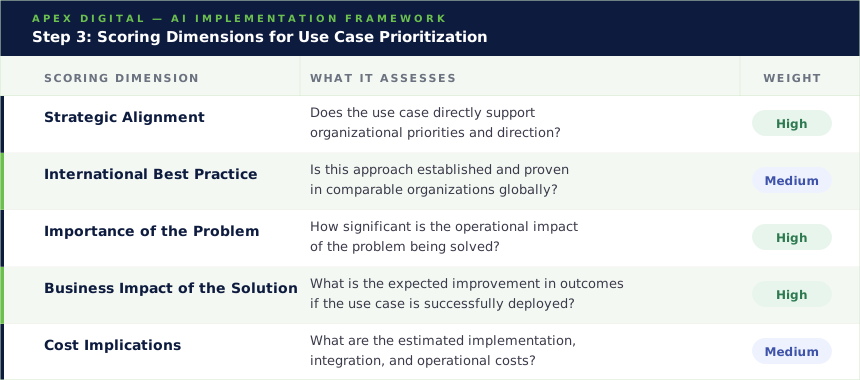
Priority alone, however, does not determine sequencing. A P1 use case requiring two years of foundational data work is not a good first initiative. Implementation effort — assessed across technical complexity, data readiness, integration requirements, and organizational change demands — is mapped alongside priority in the matrix below to determine the phased deployment sequence.
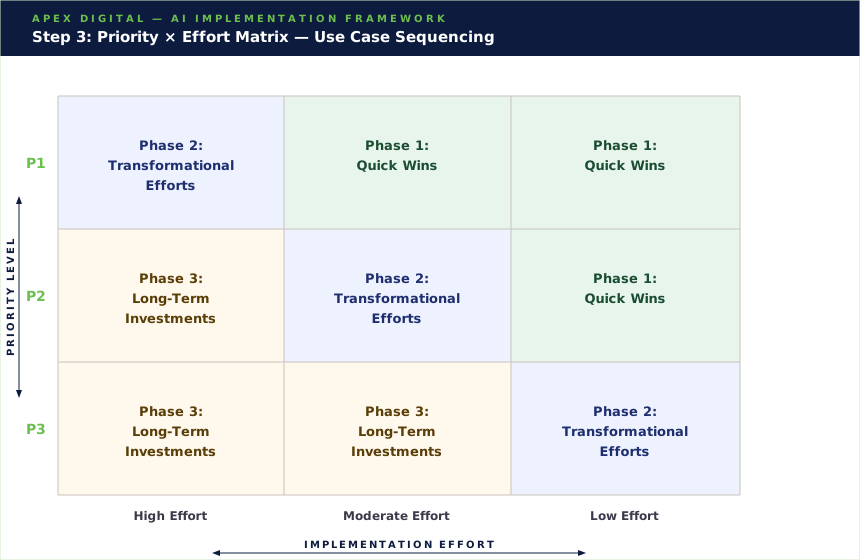
The matrix is not a static artifact. It should be revisited at regular intervals as organizational priorities evolve, data infrastructure matures, and Phase 1 results inform the feasibility of subsequent phases.
Step 4 — Define the Roadmap and Governance Structure
A sequenced use case list is not yet an implementation plan. This step translates the matrix output into a structured roadmap — phased by initiative, with a defined timeline, clear ownership at every level, and the governance structures required to ensure accountability from initiation through to deployment and beyond.
The roadmap must establish four things before any build begins. First, named roles and responsibilities: each initiative requires both a business owner accountable for outcomes and a technical lead accountable for delivery — not one or the other. Second, governance integration: risk, compliance, data privacy, and security requirements are defined at the design stage, not surfaced as obstacles at deployment. Third, decision rights: it must be explicit who approves progress between phases, who can halt an initiative, and who holds accountability if adoption targets are missed. Fourth, resourcing and timeline: each phase must be grounded in realistic capacity assessments, not aspirational delivery dates disconnected from available skills and budget.
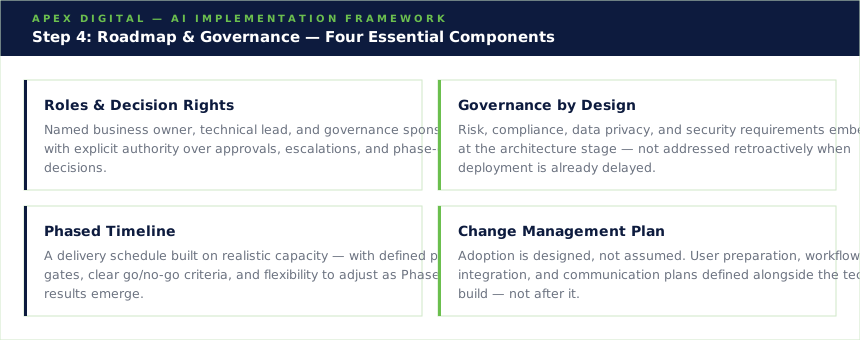
The roadmap that emerges from this step is phased, sequenced, and owned. Not a wish list of AI ambitions, but a delivery plan that organizations can execute, track, and adjust with confidence.
Step 5 — Build Capability and Track Performance
Deployment is not the end of the process — it is the beginning of the most consequential phase. Once an AI capability goes live, the organization must shift from a project delivery mindset to an operational management mindset. Two things determine whether value is actually realized at this stage: whether the people using the system are equipped to use it well, and whether the organization has the mechanisms to know whether it is working.
Capability building addresses the human side of adoption. Users need more than a training session — they need a clear understanding of what the AI capability does, how to interpret its outputs, how to handle edge cases, and how their role has changed as a result. Teams responsible for overseeing or maintaining AI systems need different skills still: the ability to monitor model behavior, detect performance degradation, and escalate appropriately. Capability building is not a one-time event; it is an ongoing investment that tracks the maturity of the capability itself.
Performance tracking addresses the measurement side. KPIs defined in Step 4 must now be actively monitored against baselines established before deployment. This includes both business KPIs — cost reduction, processing time, error rate, decision quality — and operational KPIs that signal system health, such as usage rates, model accuracy over time, and user feedback. Where performance falls short of targets, a clear escalation path must exist: to the business owner, to the governance structure, and ultimately to the executive sponsor if intervention is required.
Together, capability building and performance tracking close the loop that most AI initiatives leave open. They transform a successful deployment into a sustained organizational capability — one that improves over time rather than quietly degrading after go-live.
04 — Implementation Readiness
Before Launching: A Readiness Checklist
The following questions represent the minimum threshold of readiness that should be met before any significant resource commitment is made to an AI use case. The absence of clear answers to any of these is a risk signal — and an indicator of where preparatory work is still required before implementation begins.
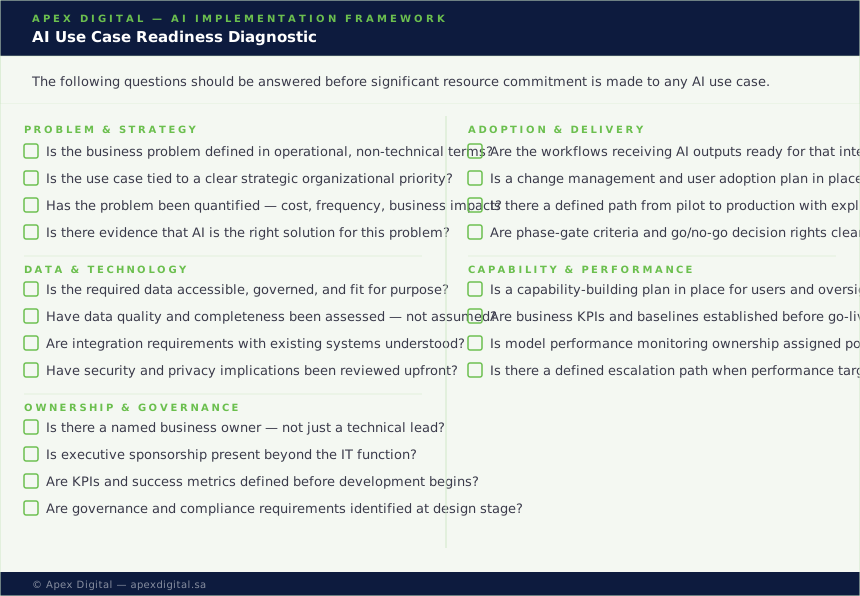
Organizations that can answer these questions confidently — before significant investment is committed — are substantially more likely to move from use case to operational capability. Those that cannot should treat each unanswered question as a workstream to resolve before implementation begins, not after.
Organizations do not create value from AI by generating more ideas. They create value by operationalizing a small number of high-impact use cases with discipline, structure, and genuine organizational commitment.
The organizations that will lead in AI-enabled operations will not necessarily be those experimenting the fastest — but those most capable of integrating AI into how decisions, processes, and operations actually function.
Explore Apex Digital's Expertise
Apex Digital is a transformation-focused consulting firm operating at the intersection of business, data and technology. We work across these domains to provide integrated solutions that support organizations from initial direction-setting through to full-scale execution.
Explore our full range of services to understand how we support organizations in delivering meaningful and sustained transformation