
Cyber Resilience by Design:
Integrating GRC into the Tech Stack
February 19 , 2026
01 - The Misdiagnosis
GRC as a Reporting Function, Not a Control Function
The dominant model for GRC in most organizations is event-driven. An annual audit is scheduled. Evidence is collected. Findings are documented. A certification is renewed or a regulatory submission is filed. The cycle resets. This model has a structural flaw that no amount of process improvement will fix: the environment being audited does not stand still. Systems are deployed, configurations drift, access rights accumulate, third parties are onboarded, and code is pushed to production — continuously, between audit cycles. The gap between what the last audit found and what the environment actually looks like six months later is precisely where incidents live.
The misdiagnosis is treating GRC as a documentation discipline rather than a control discipline. A policy document is not a control. A risk register that no one references between annual reviews is not risk management. A compliance certificate does not mean that the controls it certifies are functioning today, in the production environment, against the actual data flows of the organization. These are statements of organizational intent — valuable, but not the same as organizational capability.
GRC by design means something different. It means that governance is embedded in how decisions get made — not just documented in a framework that sits beside the decision-making process. It means that risk is embedded in how systems are built — architecture reviews, threat models, and control requirements written into engineering workflows rather than reviewed after the fact. And it means that compliance is an output of how operations run — continuous measurement and automated evidence generation rather than a periodic scramble to demonstrate that policies exist.
A control that exists in a policy but has no implementation owner in the system architecture is not a control. It is a statement of intent.
The distinction matters because it changes where the work happens. In the event-driven model, GRC is a function that operates on the organization. In the design model, GRC is a property of the organization — one that has to be built into the way technology is designed, owned, and operated.
02 - What the Standards Contribute
The Genuine Value, and the Gaps
The major standards and frameworks each contribute something real. The problem is not their content; it is how they are typically implemented — and what each one leaves unresolved when used in isolation.
ISO/IEC 27001
ISO 27001’s most important contribution is the concept of an Information Security Management System as a living organizational capability rather than a one-time certification artifact. The control domain structure (now 93 controls across four themes in the 2022 revision) gives organizations a comprehensive vocabulary for describing what needs to be in place. What it does not tell you is how to integrate those controls into engineering workflows. Most organizations implement ISO 27001 by mapping controls to policy documents and generating evidence for auditors. The controls exist on paper. Whether they exist in the architecture is a separate question that the standard leaves to the organization to answer.
NIST Cybersecurity Framework 2.0
The NIST CSF’s six-function model — Govern, Identify, Protect, Detect, Respond, Recover — is the most useful high-level vocabulary available for thinking about cybersecurity posture as a continuous lifecycle rather than a point-in-time state. The addition of Govern as a first-class function in CSF 2.0 reflects exactly the kind of accountability structure this article argues for. The gap is in operationalization: organizations frequently implement the CSF as a self-assessment exercise rather than an operational model. The functions describe what should be true; they don’t prescribe how to make it true in a specific technology environment or how to measure whether it remains true over time.
COBIT 2019
COBIT’s contribution is its insistence on separating governance from management — and anchoring IT governance to business objectives rather than to technical controls. The cascade from enterprise goals to alignment goals to governance and management objectives is conceptually sound. The problem is that COBIT is dense enough that most technology organizations cannot operationalize it directly. It describes a comprehensive governance system; it does not describe how to design one at the architecture level of a specific organization.
SOC 2 Trust Services Criteria
SOC 2’s five criteria — Security, Availability, Processing Integrity, Confidentiality, and Privacy — translate well into system-level design requirements. They provide a practical design lens for architects making decisions about access controls, encryption, logging, availability targets, and data handling. The failure mode is cultural: organizations treat SOC 2 as a vendor due diligence requirement rather than an internal design discipline. The criteria describe properties that systems should have; the question is whether those properties are designed in from the start or bolted on before an audit.
The Three Lines of Defense
The IIA’s three lines model — first line (business and system owners), second line (risk and compliance functions), third line (internal audit) — provides the accountability structure that the other frameworks largely leave implicit. Its failure mode in practice is that the first line frequently does not understand what it is accountable for. Business and system owners hold formal accountability for controls but often lack the technical literacy to verify that those controls are in place, functioning, and aligned to the risk appetite the board has expressed.
The synthesis across all five is what is consistently missing: a unified model that connects board-level governance intent to architecture-level design decisions to operational control execution to continuous measurement. Each standard addresses part of this chain. None addresses the whole. That is the gap this framework fills.
03 - The Apex GRC Architecture Model
Four Layers From Governance to Assurance
The framework below organizes GRC not as a set of parallel activities but as an integrated architecture — four layers that translate governance intent, progressively, into operational controls and continuous measurement. Each layer has a defined scope, ownership structure, and design obligations. The layers are connected: decisions made at Layer 1 constrain design choices at Layer 2, which determine what gets implemented at Layer 3, which defines what gets measured at Layer 4. Gaps in any layer propagate downward.
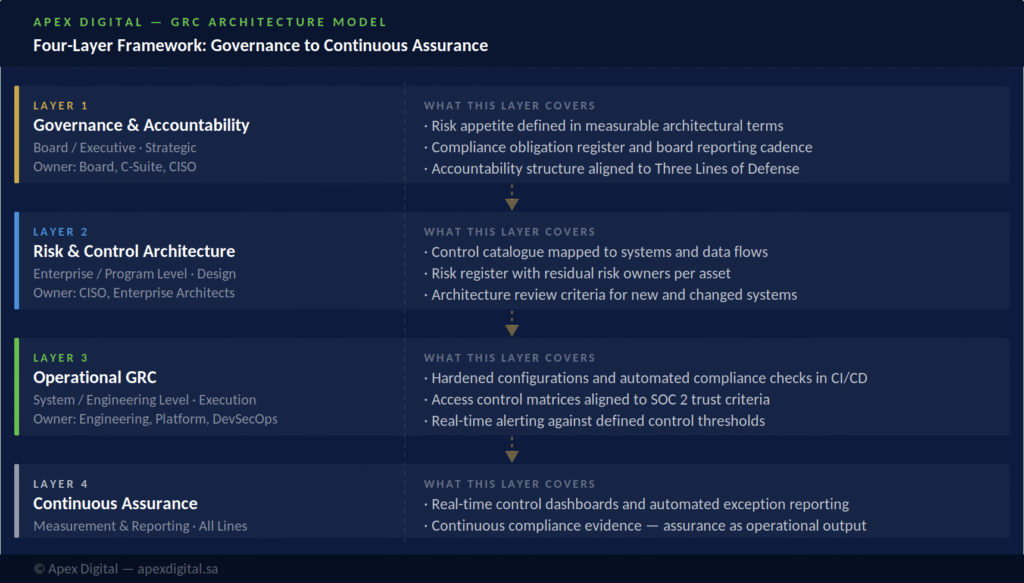
Layer 1 — Governance & Accountability
The board and executive team define risk appetite, compliance obligations, and accountability structures. This is not new. What is different in the design model is the requirement that risk appetite be expressed in terms the architecture team can actually design against. Qualitative statements — “we have a low tolerance for data exposure risk” — do not translate into engineering decisions. Measurable thresholds do: maximum acceptable data exposure window, tolerated system downtime, permissible third-party access scope. Layer 1’s obligation is to produce governance intent that Layer 2 can operationalize.
Layer 2 — Risk & Control Architecture
This layer translates governance intent into a control framework mapped to the organization’s actual technology landscape. It draws on ISO 27001 control domains and NIST CSF functions as structural vocabulary — not as compliance checklists, but as a shared language for describing what needs to be true about each system and data flow. Controls are mapped to assets, not to document sections. Residual risk owners are named by system, not by organizational unit. New and changed systems pass through architecture review criteria derived from this layer before they reach production.
Layer 3 — Operational GRC
This is where GRC becomes a design discipline rather than a governance one. Controls are implemented as technical configurations, automated checks embedded in CI/CD pipelines, access policies enforced by the platform, and monitoring rules that fire against defined thresholds. The SOC 2 Trust Services Criteria are useful here as a design lens: they describe properties that systems should have — security, availability, processing integrity, confidentiality, privacy — in terms that translate directly into engineering decisions. The design principle that governs this layer: if a control requires a human to remember to do something periodically, it is not operationalized. It is aspirational.
Layer 4 — Continuous Assurance
Point-in-time audits are replaced by continuous measurement of control effectiveness. The three lines of defense structure provides the accountability model: system owners (first line) generate control telemetry as a byproduct of operating the systems; the risk and compliance function (second line) aggregates and interprets it; internal audit (third line) validates the measurement model itself, not just the outputs. External auditors receive continuous evidence rather than a retrospective collection exercise. Assurance is an output of the operational system, not an additional process imposed on top of it.
04 — Failure Modes
Where Operationalization Actually Breaks
The four-layer model describes what should be true. The more useful analysis is what goes wrong when organizations attempt to move in this direction — and how the design approach addresses each failure mode specifically. The four most common points of breakdown are structural, not technical.
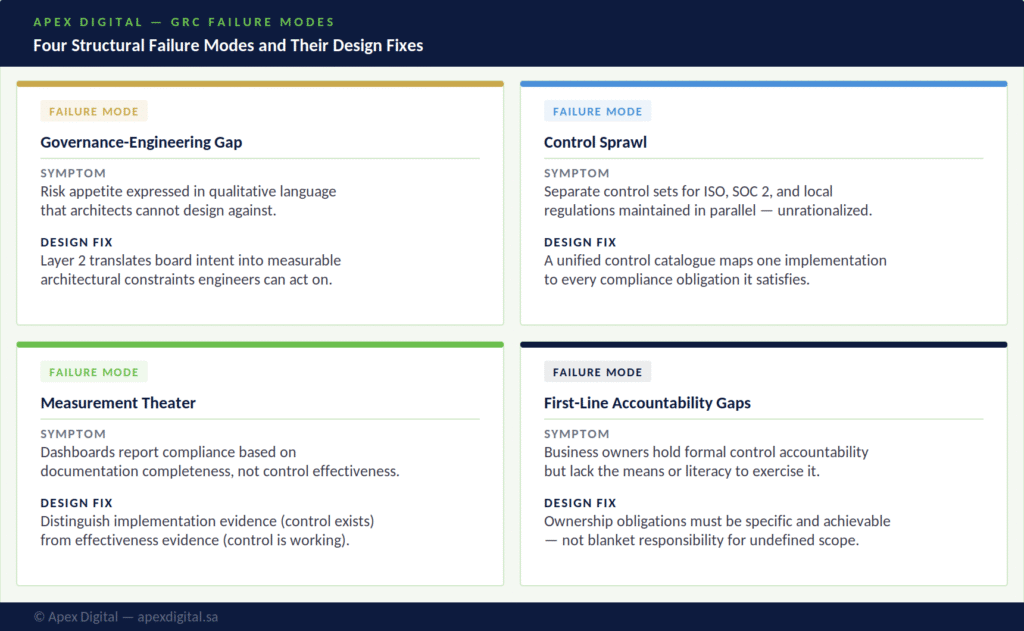
The Governance-Engineering Gap
Risk appetite defined by the board in qualitative language — “low tolerance for reputational risk,” “moderate acceptance of operational disruption” — creates an instruction that the architecture team cannot act on. The gap is not one of intent but of translation. Layer 2’s core function is precisely this translation: taking board-level statements and expressing them as architectural constraints that engineering teams can build against. This requires the enterprise architecture and risk functions to work together on a vocabulary that both the boardroom and the build pipeline can use.
Control Sprawl
As organizations accumulate compliance obligations — ISO 27001, SOC 2, NCA’s Essential Cybersecurity Controls, SAMA requirements, PDPL — they tend to manage each one separately. The result is multiple overlapping control frameworks, each maintained by different teams, with no rationalization across them. A single technical control — say, encryption at rest for a specific data category — ends up implemented, documented, and evidenced separately for each compliance regime. The fix is a unified control catalogue: one catalogue that maps a single control implementation to every compliance obligation it satisfies, maintained by Layer 2, evidenced once at Layer 3, and reported at Layer 4. The compliance frameworks become overlays on a single architecture, not parallel architectures.
Measurement Theater
This is the most insidious failure mode because it produces output that looks like assurance. A dashboard reports that 94% of controls are compliant. What it is actually measuring is whether documentation exists: policies are approved, procedures are documented, evidence was submitted for the last audit cycle. The underlying question — whether the controls are actually functioning in the production environment today — is not being asked. The diagnostic distinction is between implementation evidence (the control was set up) and effectiveness evidence (the control is working). Layer 4 is designed around the latter: telemetry from the operational environment, not documentation from the compliance process.
First-Line Accountability Gaps
The three lines of defense model assigns primary accountability for controls to the first line — the business functions and system owners who operate the assets being controlled. In practice, these owners frequently cannot exercise that accountability because they lack the technical literacy to verify control status, and the obligations assigned to them are too broad to act on. The design fix is not to relocate accountability to the second line — that defeats the structural purpose of the model. It is to define first-line obligations at a level of specificity and achievability that the owner can actually meet. An obligation that reads “ensure all access to the payments system is appropriate” is not an obligation — it is a wish. An obligation that reads “review and certify the access list for the payments system each quarter, using the report generated by the IAM platform, and raise exceptions within five business days” is one that a non-technical owner can fulfill.
05 — Strategic Outcome
From Compliance to Resilience
Organizations that successfully embed GRC into their architecture develop a different relationship with risk — one that is qualitatively distinct from the compliance-oriented model, not just more efficient. The difference shows up clearly when something goes wrong.
In a compliance-oriented organization, an incident triggers a scramble. Logs are retrieved and analyzed retrospectively. Controls that should have fired are found to be misconfigured or unenforced. The post-mortem reveals that the control was documented but not implemented, or implemented but not monitored, or monitored but not connected to any response process. Regulators ask for evidence that controls were in place and operational; the evidence does not exist in the form required. The incident costs not just what the incident costs — it costs the additional overhead of demonstrating to regulators, customers, and insurers that the organization has a credible control environment, when the environment itself has just demonstrated that it did not.
In a resilience-oriented organization, the same incident looks different. The detection comes from continuous monitoring at Layer 3, not from a third-party notification or a customer complaint. The response process is structured and exercised, not improvised. The telemetry needed to understand what happened, what was affected, and what was not is available from the operational environment. The compliance evidence for regulators is drawn from the same operational record. The organization does not pass the audit more easily because it prepared better for the audit — it passes because the audit is measuring a control environment that was designed to be measurable.
The strategic distinction between these two orientations is not primarily a technology question. The tools required to build a continuous assurance environment exist. Security information and event management platforms, cloud-native configuration monitoring, identity governance tooling, automated policy-as-code frameworks — the technical components of Layer 3 and Layer 4 are available to any organization of sufficient scale. What most organizations lack is not the technology. It is the architectural thinking to connect governance intent, through the control framework, through engineering practice, to operational measurement — and the organizational design to sustain that connection over time as systems change, teams turn over, and obligations evolve.
GRC by design is, in the end, an organizational design problem that has been misidentified as a compliance problem. The compliance programs exist. The certifications have been obtained. The audits have been passed. And the incidents continue. The answer is not more compliance. It is a different architecture — one in which the controls that governance requires are the same controls that engineering builds and operations measures. When those three things are the same control, compliance is a byproduct. Resilience is the point.
The organizations that will define cybersecurity leadership over the next decade are not those with the largest security budgets or the most certifications. They are those that stopped treating GRC as a parallel track and started treating it as a design constraint — one that shapes how systems are built, how risk is owned, and how resilience is measured. Compliance will follow. Resilience is the point.
Explore Apex Digital's Expertise
Apex Digital is a transformation-focused consulting firm operating at the intersection of business, data and technology. We work across these domains to provide integrated solutions that support organizations from initial direction-setting through to full-scale execution.
Explore our full range of services to understand how we support organizations in delivering meaningful and sustained transformation