
Data-First Operations:
Reengineering Workflows for the Intelligent Age
June 2, 2026
01 - The Real Problem
Data Availability vs Data Operationalization
There is a distinction that rarely gets named clearly enough in transformation programs: the difference between data availability and data operationalization. The first is a technology problem — connecting systems, building pipelines, populating dashboards. Organizations have spent significant resources solving it. The second is an organizational problem — embedding data into the rhythm of how decisions get made, how performance gets managed, and how resources get deployed. Most organizations are still at the start of that journey.
What distinguishes organizations that have genuinely operationalized data is not their technology stack. It is the degree to which their operational processes, decision rights, and accountability structures have been redesigned with real-time information as an input — not a retrospective record. That redesign is harder, slower, and more politically complex than any technology implementation. It is also the work that actually moves performance.
Data availability is a technology achievement. Data operationalization is an organizational one — and far fewer organizations have crossed that line.
02 - Diagnosis
Why Dashboards Exist but Decisions Don't Change
Organizations invest in visibility tools and then find, sometimes years later, that behavior has not shifted in the ways they expected. This is not a failure of will. It reflects several structural realities that technology investments consistently underestimate.
Absence of a Decision Trigger
A dashboard that shows you something is declining does not tell you what to do about it, who is responsible, or at what threshold a response becomes mandatory. Without those parameters, the dashboard becomes informational rather than operational — something people note rather than act on. Insight without a defined response pathway is ambient noise.
Role Misalignment
Real-time data is only valuable to the person with both the visibility and the authority to act. In many organizations, those two things are separated. The analyst can see the problem. The manager who could authorize a response is three levels removed from the data and receives a summary once a week. The latency is not technical — it is organizational.
Cultural Barriers
Organizations with long histories of HiPPO decision-making — where the Highest Paid Person’s Opinion carries more weight than any dataset — do not transform their decision culture by deploying BI tools. The technology arrives and gets absorbed into the existing culture, which finds ways to use it selectively: to confirm decisions already made, to support narratives already held, or to satisfy audit requirements without changing behavior.
Metric Overload
When every function produces its own dashboards with its own KPIs, leadership teams face a fragmented picture that requires significant interpretive effort. The cognitive load of synthesizing fifty metrics across ten systems is high enough that most executives default to the two or three numbers they have always tracked. More data visibility, paradoxically, can produce less clarity.
03 - The Apex Framework
The Operational Data Maturity Model
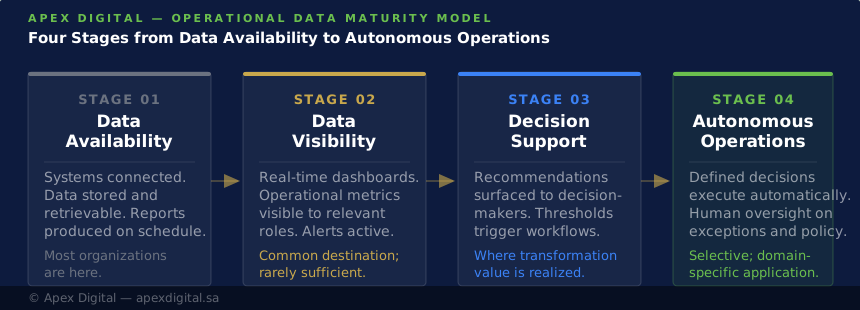
Apex Digital works with organizations across four stages of data-operations maturity. The stages are not purely technical — each requires a distinct set of organizational capabilities, governance structures, and behavioral changes to unlock. Understanding where an organization sits, and what the next stage actually requires, is the starting point for any serious transformation program.
The model below maps the four stages and what characterizes each — not as an aspiration, but as a diagnostic tool for understanding what is actually in place and what is missing.
Each stage has a distinct character — and a distinct reason organizations get stuck in it. Understanding the sticking point is more useful than knowing the destination.
Stage 1 — Data Availability
Data Availability is where most organizations have arrived after years of ERP consolidation, data warehouse investment, and integration projects. The data exists. Systems talk to each other, or at least to a central repository. Reports are produced. This stage feels like progress because it is — but it is the foundation, not the outcome. Organizations get stuck here primarily because the reporting cadence becomes institutionalized: the weekly pack, the monthly board deck, the quarterly review. The rhythm of reporting becomes the rhythm of management, and nobody questions whether that rhythm is fast enough for the decisions being made.
Stage 2 — Data Visibility
Data Visibility is the stage most transformation programs target and declare victory at. Dashboards are live. Metrics are accessible in near real-time. Alerts fire when thresholds are breached. This is a genuine capability step — but it is also where the organizational gap becomes most visible. The data is moving faster than the decisions. Alerts go unactioned. Dashboards are reviewed in scheduled meetings rather than triggering immediate responses. The tools are at Stage 2; the operating model is still at Stage 1. This gap — which organizations often misread as a technology problem requiring better dashboards — is in fact a governance and accountability problem.
Stage 3 — Decision Support
Decision Support is where the real value of data investment is realized. The system does not just show what is happening — it surfaces what to do about it, routes the recommendation to the person with authority to act, and tracks whether action was taken. This requires redesigning decision workflows, not just reporting. It requires defining thresholds, owners, and response protocols. The technology at Stage 3 is not necessarily more sophisticated than at Stage 2 — the difference is in how tightly the data is coupled to the decision process. Most organizations have the data to reach Stage 3 in at least one or two functions. The constraint is organizational will, not technical capacity.
Stage 4 — Autonomous Operations
Autonomous Operations is frequently cited as the goal and frequently misapplied. Full autonomy — where defined categories of decisions execute without human intervention — is appropriate in narrow, high-frequency, well-understood domains: pricing adjustments within defined bands, logistics rerouting, automated compliance flagging. It is not appropriate for decisions involving contextual judgment, ethical considerations, or consequences that cannot be reversed. The organizations that reach Stage 4 productively are those that have been rigorous about which decisions qualify for it. Those that rush to Stage 4 across the board tend to create accountability gaps they discover only when something goes wrong.
04 — Automation Boundaries
Knowing What to Automate — and What to Protect
The progression toward Stage 4 raises a question that many organizations answer too casually: which decisions should actually be automated? The answer is rarely “as many as possible.”
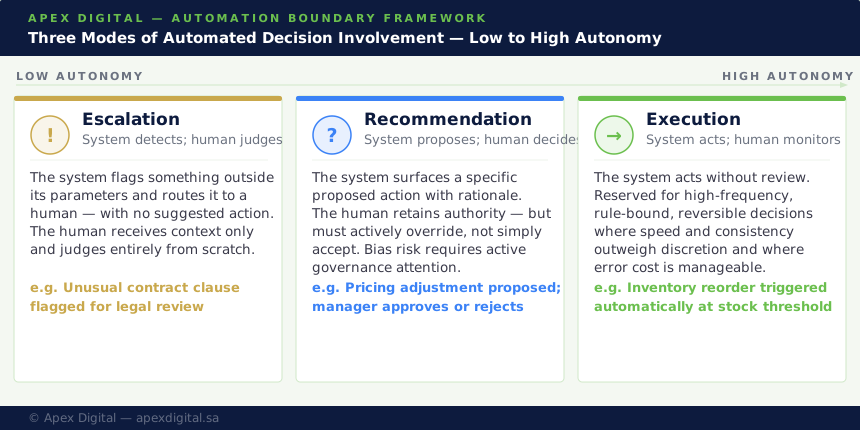
The distinction Apex draws is between three modes of automated decision involvement: execution, recommendation, and escalation. Execution means the system acts without human review — appropriate for high-frequency, well-defined, reversible decisions where the cost of occasional error is manageable and consistency has more value than discretion. Recommendation means the system proposes and the human decides — the right model for a much wider range of decisions, including consequential ones. Escalation means the system identifies that something falls outside normal parameters and routes it to a human — a form of automation that reduces cognitive load without removing human judgment from the loop.
The question is never “can this decision be automated?” It is “what is the cost when it’s wrong, and who is accountable for that cost?”
Two failure modes are worth naming. The first is over-automation: extending algorithmic execution into domains where the decision parameters are not actually well-defined, where context matters in ways the model cannot capture, or where the consequences of a wrong call are irreversible. Organizations that automate too broadly often discover the failure only after the harm is done — a pricing algorithm that offends customers in a way no human reviewer would have permitted, a risk model that generates discriminatory outcomes at scale. Speed and consistency are genuine benefits of automation. They do not outweigh accountability.
The second failure mode is less discussed: automation bias in the recommendation layer. When a system surfaces a recommendation — even when a human retains formal authority to reject it — the psychological tendency is to approve. The friction required to override a system output is higher than the friction of accepting it, particularly in time-pressured operational environments. This is not a technology problem. It is a human factors problem, and it requires governance design to address: mandatory rationale fields for overrides, periodic review of override rates, calibration sessions where teams examine whether system recommendations were actually correct. Organizations that treat the recommendation layer as a solved problem because a human is technically in the loop are underestimating how much the loop has been shortened.
Human judgment must remain primary wherever the decision involves situations outside the model’s defined parameters, where ethical dimensions are present that cannot be reduced to an optimization function, or where the consequences of error are irreversible or reputationally significant. Organizations that automate these categories — often because the technology makes it possible — are not becoming more intelligent. They are offloading accountability to a system that cannot bear it. The appropriate question before any automation decision is not “is this technically feasible?” It is: if this goes wrong at scale, who is responsible, and would that person accept that responsibility?
05 — Making It Sustainable
The Governance Architecture That Holds It Together
Operational data programs that lack governance frameworks tend to follow a recognizable lifecycle: an energetic launch, impressive early dashboards, gradual drift as data quality degrades and accountability structures erode, eventual abandonment when leadership attention moves elsewhere. The technology remains. The operational discipline does not.
Sustainable data-driven operations depend on governance functioning at three distinct levels — each with a different owner, a different time horizon, and different failure modes. These levels are not sequential; they operate simultaneously. An organization can have excellent technical governance and non-existent decision governance. Most do.
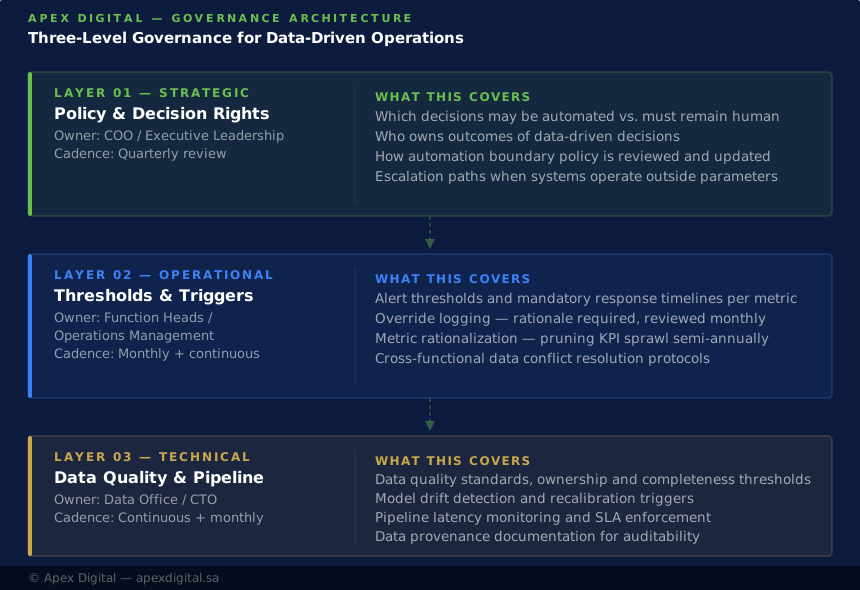
Of the three layers, strategic governance is the one most frequently absent — not because organizations don’t care about decision rights, but because those conversations are uncomfortable. Formally documenting which decisions may be automated, and who is accountable when they go wrong, forces a level of organizational clarity that most leadership teams avoid until a failure makes it unavoidable. The organizations that establish this layer proactively are the ones that can move quickly through the maturity stages without creating liability gaps they discover only in hindsight.
A note on override logging, which sits in the operational layer and is consistently undervalued: every time a human overrides a system recommendation, that event contains signal. Either the recommendation was wrong, the person’s judgment was better, or the person was acting on information the system did not have. Capturing and reviewing these overrides is one of the most effective feedback mechanisms available for improving automated decision support over time. Organizations that treat overrides as evidence of system failure are missing the learning opportunity they represent.
06 — From Here
A Sequence, Not a Program
The path from data availability to data-driven operations does not require a multi-year transformation program before any value is realized. It requires sequencing: getting the right things in place in the right order, so that each step creates the conditions for the next. The following sequence is how Apex typically structures the early work with clients — moving through diagnosis, design, and operationalization in a way that produces visible results at each stage rather than deferring value to a distant go-live.
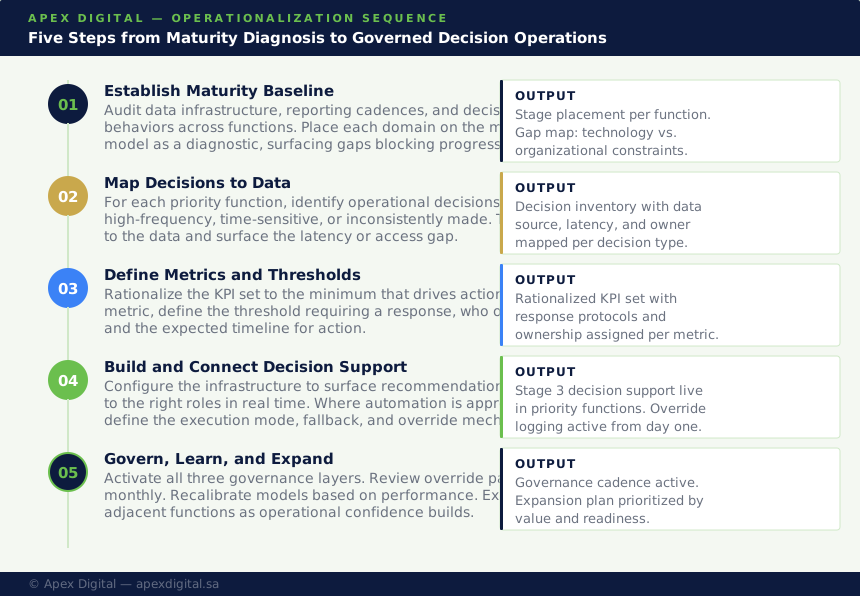
What distinguishes organizations that move through this sequence successfully is not the sophistication of their technology. It is the willingness to make clear organizational decisions at each step: who owns this, what is the threshold for action, which decisions are off the table for automation. Those decisions are not technically complex. They require the kind of clarity and accountability that data-first operations ultimately demands — and that makes the data worth having in the first place.
Data-first operations is not a technology program that happens to affect how people work. It is an organizational redesign program that is enabled by technology. The organizations that understand this distinction early build the governance, accountability, and behavioral foundations that make technology investments productive. Those that don’t spend significant resources building dashboards that nobody acts on — and wonder, eventually, why the data never changed anything.
Explore Apex Digital's Expertise
Apex Digital is a transformation-focused consulting firm operating at the intersection of business, data and technology. We work across these domains to provide integrated solutions that support organizations from initial direction-setting through to full-scale execution.
Explore our full range of services to understand how we support organizations in delivering meaningful and sustained transformation