
Governing AI at Scale:
The Management Challenge Behind Enterprise AI
June 16, 2026
01 - Context
When AI Becomes a Management Problem
The first wave of AI investment looked largely the same across industries. A forecasting model here. An intelligent document processing pilot there. A customer-facing chatbot that generated enough early results to justify the next initiative. At this stage, governance is uncomplicated. Each project has a sponsor, a team, and a relatively contained scope. The organization learns from it — or doesn’t — and moves on.
But organizations that take AI seriously don’t stop at one or two pilots. They accumulate them. Over time, what began as a series of discrete experiments becomes a landscape of concurrent initiatives spread across business units, functions, and technology stacks. This is when the questions change.
Which initiatives should be funded when resources are limited? Who owns an AI system once it goes live — the team that built it, the business unit that uses it, or someone else entirely? When two departments want to pursue similar capabilities, who decides whether they consolidate or proceed independently? When a model’s performance degrades six months after deployment, who is responsible for catching it, and what do they do about it? How does the organization assess risk consistently when every initiative carries a different risk profile?
None of these are technology questions. They are management questions — and they tend to surface only after the organization has already invested enough in AI that the absence of answers is visible and costly. The organizations that get ahead of them don’t do so because they have better AI tools. They do so because they have built the governance structures to manage AI as an organizational capability rather than a project category.
02 - The Problem
Why Existing Governance Structures Fall Short
The instinctive response to a growing portfolio of AI initiatives is to apply the governance mechanisms that already exist for technology projects — stage-gate reviews, steering committee approvals, change control processes. These frameworks have served organizations well for years. The problem is that AI introduces a set of properties that standard project governance was not designed to manage.
Data dependency means an initiative’s feasibility is determined by whether the right data exists, is accessible, and is of sufficient quality — a constraint that often surfaces weeks into development rather than at approval. Model uncertainty means outputs evolve as the operating environment shifts, so the governance question is not only whether the model worked at deployment, but whether it continues to work over time. Regulatory and ethical considerations — privacy, fairness, transparency — need to be embedded at the point of approval, not discovered as a final sign-off constraint. And unlike conventional software, deploying an AI system does not complete a deliverable; it creates an ongoing obligation for monitoring, maintenance, and performance management.
AI governance is not a harder version of software project management. It is a different category of management challenge — one that persists well beyond the point where traditional project oversight ends.
When governance is absent or ad hoc, the most visible consequence is not dramatic failure — it is inconsistency. Different initiatives advance through different criteria. Some receive rigorous scrutiny; others proceed on the strength of internal sponsorship. Risk is assessed differently across teams, accountability distributes across functions in ways no single person can map, and leaders asked to make portfolio-level decisions are working without the structured information those decisions require.
The response organizations typically reach for — more documentation, more steering committee meetings — adds process weight without improving decision quality. What is missing is not more review. It is structured criteria for what gets reviewed, by whom, at what point, and against what standard. This is the problem that a phase-gate framework is designed to solve.
03 - The Apex Framework
A Phase-Gate Delivery Model for AI Governance
A phase gate is a predefined decision point that an initiative must pass before advancing to the next stage. The concept is not new — variants have existed in product development, capital investment, and pharmaceutical R&D for decades. What is new is the specific structure required to make it work for AI, where the stakes at each gate are different, the dependencies more complex, and the post-deployment obligations more demanding than in most technology contexts.
The Apex delivery framework organizes AI initiatives into three sequential phases — Pre-Implementation, Implementation & Build, and Operations — each containing a defined set of phase gates. In total, the framework spans twelve gates, structured to match the natural decision rhythm of an AI initiative: from initial strategy through to live operations and handover. Each phase reflects a different management mode: pre-implementation follows a waterfall discipline focused on structured approvals and sourcing; the build phase combines waterfall planning with agile development sprints; and operations manages the transition from hypercare into steady-state delivery.
The framework below maps all twelve phase gates across the three delivery phases, showing how each gate is sequenced within the broader initiative lifecycle.
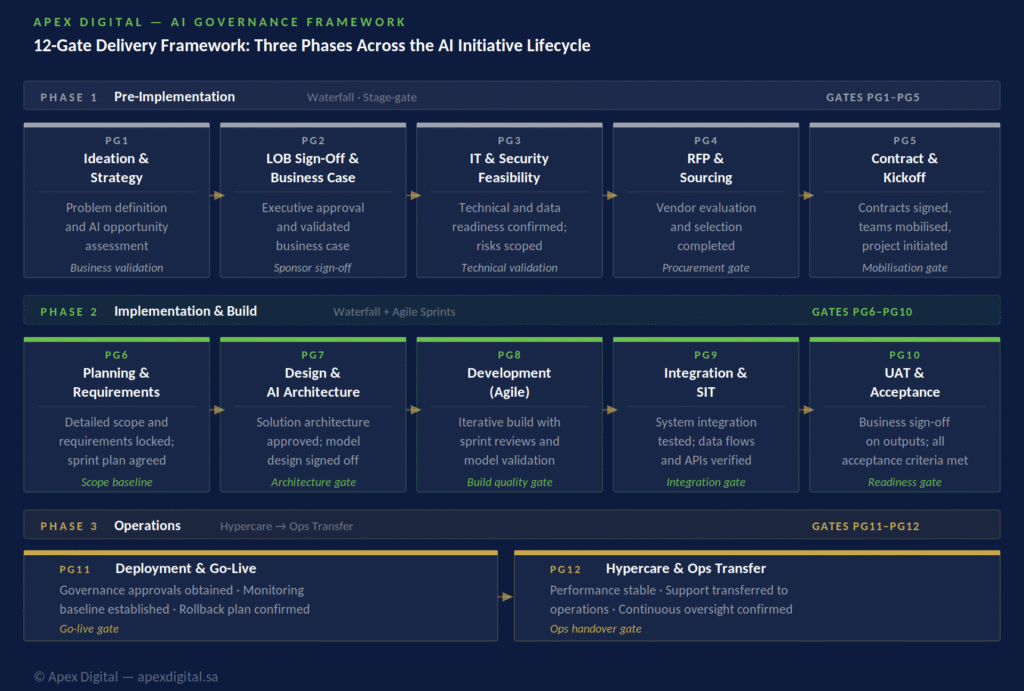
The twelve gates are distributed across three phases that reflect the natural management rhythm of an AI initiative — from strategy and sourcing, through development, to live operations and institutional handover.
The number of gates is not arbitrary. It reflects a recognition that the failure modes in AI delivery are concentrated at specific transitions: between strategy and committed investment, between design intent and technical feasibility, between build completion and organizational readiness, and between deployment and sustained operational performance. A gate at each of these transitions forces the relevant questions before they become expensive to resolve.
What gives the framework its consistency across all twelve gates is a common structure applied to each one. Every gate is governed by four defined components, applied uniformly regardless of where it sits in the lifecycle.
The diagram below illustrates how these four components operate together at each gate decision point.
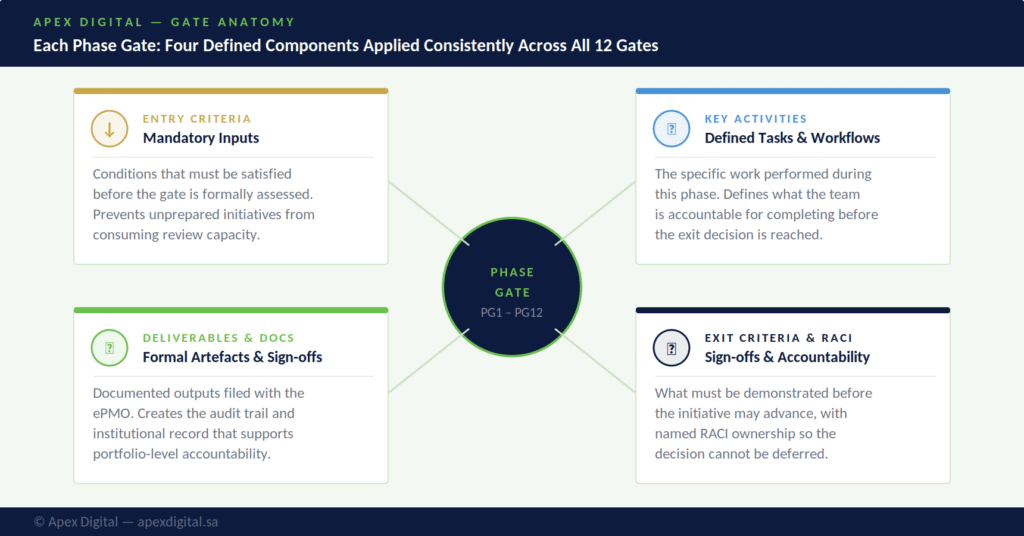
The four components — Entry Criteria, Key Activities, Deliverables & Docs, and Exit Criteria with RACI — are applied to every gate in the framework, creating a consistent decision standard across all twelve checkpoints and all three delivery phases.
The separation of entry and exit criteria is deliberate and consequential. Entry criteria determine whether an initiative is ready to be assessed at a gate — they prevent teams from arriving at a decision point with open questions that should have been resolved beforehand. Exit criteria determine whether the initiative may advance — they establish what must be demonstrated, not merely claimed. Applied consistently, this structure removes the ambiguity that allows poorly prepared initiatives to progress on internal momentum rather than on evidence.
The deliverables component — formal artefacts filed with the ePMO — is what converts individual gate decisions into an institutional record. It is what allows a new programme director to reconstruct the decision history of an initiative, what makes the organization auditable, and what creates the accountability trail that portfolio-level governance depends on.
04 — Organizational Impact
What a Phase-Gated Model Actually Changes
The case for phase gates is not primarily about compliance or documentation. It is about making AI initiatives more likely to reach operational maturity, and giving the organization the structure to manage multiple initiatives simultaneously without losing accountability over any of them.
Accountability becomes specific. When every gate has a named owner in the RACI, accountability no longer diffuses across a steering committee where everyone is nominally responsible and therefore no one is operationally responsible. The business sponsor who approved PG2 has a stake in the initiative at PG11. The architecture lead who signed off at PG7 cannot disclaim responsibility when integration issues surface at PG9.
Decision-making becomes consistent. A shared gate structure applies the same entry and exit criteria to every initiative, regardless of which business unit sponsors it or how much internal momentum it has built. This does not remove judgment — gate reviews still require experienced decision-makers — but it ensures that judgment is applied to the same evidence across all initiatives, not to whichever arguments a particular sponsor chooses to present.
Risk surfaces earlier. The most costly failure mode in AI delivery is the initiative that clears informal approvals, consumes significant build resources, and then surfaces a fundamental risk at deployment. Data privacy issues discovered after an integration is built. Regulatory requirements raised at a go-live sign-off that no one thought to raise at PG3. Phase gates, by making these reviews mandatory at earlier checkpoints, are specifically designed to catch these issues before they become expensive to resolve.
Finally, a portfolio of concurrent initiatives — each at a different gate, each with a different risk profile — becomes manageable through a common structure. Leaders can see, across the portfolio, which initiatives are advancing, which are stalled, and where intervention is needed. The phase-gate framework does not eliminate complexity. It makes complexity governable.
05 — Conclusion
Building the Capability to Govern What You Build
The organizations that will lead in AI-enabled operations over the next decade are unlikely to be those that moved fastest in 2024 and 2025. They will be the organizations that, somewhere in the middle of that acceleration, made a deliberate decision to govern what they were building — to create the structures that would allow AI investment to compound rather than accumulate as technical debt and organizational confusion.
A phase-gate framework is one instrument in that effort. It is not a substitute for leadership commitment, for genuine data readiness, or for the cultural shift that makes AI capabilities actually used rather than merely deployed. But it is the structural prerequisite for managing AI at scale — the mechanism that converts good intentions about accountability and consistency into actual organizational practice.
The shift from governing individual AI initiatives to governing a portfolio of them is ultimately a shift in how an organization thinks about AI itself. Not as a series of projects with defined end dates, but as an ongoing organizational capability that requires sustained investment, structured oversight, and continuous management attention. The governance framework is not the destination. It is what makes the destination reachable.
Apex Digital works with organizations at each stage of this journey — from designing the gate structure and ownership model, to embedding governance into active portfolio management. The starting point is always the same: understanding where existing governance falls short, and building the structure that can carry the weight of AI at scale.
Successful AI transformation is consistently portrayed as a technology challenge. In practice, the organizations that scale AI sustainably are distinguished not by their access to tools or their technical ambition — but by the management discipline to govern AI consistently, make informed decisions at every stage of the lifecycle, and maintain accountability long after any individual initiative goes live. The differentiator is not what an organization can build. It is whether it has the governance infrastructure to see it through.
Explore Apex Digital's Expertise
Apex Digital is a transformation-focused consulting firm operating at the intersection of business, data and technology. We work across these domains to provide integrated solutions that support organizations from initial direction-setting through to full-scale execution.
Explore our full range of services to understand how we support organizations in delivering meaningful and sustained transformation