
Integration as Strategy:
The Hidden Challenge Behind Modern Enterprise Architectures
May 11, 2026
Disconnected systems, fragmented data environments, and siloed processes are not infrastructure problems; they are strategic constraints, and organizations that treat integration as a technical exercise are paying for that mistake in ways they cannot yet measure.
01 - The Scale of the Problem
A Fragmentation Problem That Has Been Normalized
Enterprise technology environments have grown substantially more complex over the past decade, largely without a corresponding increase in coordination. Organizations now operate an average of 897 applications across their technology stack, according to MuleSoft’s 2025 Connectivity Benchmark Report — a figure that has nearly doubled since 2015. Of those applications, the average organization reports that 41% remain unintegrated: siloed systems generating duplicate data, inconsistent records, and operational blind spots that no individual system can see across.
This is not primarily a technology problem. It is the cumulative result of procurement decisions made independently of each other — each system selected on its own merits, each implementation treated as a contained project, and each integration left to be solved later. “Later” has arrived for most organizations, and the cost of deferred integration is now visible in places leadership did not expect: in AI initiatives that cannot access clean data, in analytics dashboards that contradict each other, in finance processes that still close on spreadsheets.
What is striking is not that fragmentation exists — it is that it has been normalized. Most organizations have learned to operate around their integration gaps rather than through them. Manual reconciliation, parallel workflows, and departmental shadow systems are not exceptions. They are the standard operating procedure for organizations that never resolved the connective architecture underneath their enterprise stack.
of enterprise applications remain unintegrated on average, generating duplicate data and operational blind spots
MuleSoft Connectivity Benchmark Report, 2025
of IT leaders report that integration challenges are a significant barrier to implementing AI effectively
MuleSoft Connectivity Benchmark Report, 2025
of AI projects lacking AI-ready data will be abandoned, according to Gartner — data readiness starts with integration
MuleSoft Connectivity Benchmark Report, 2025
These numbers describe a systemic condition, not individual project failures. The organizations in these studies are not poorly managed. Most of them have made significant technology investments. What they have not done is treat integration as a foundational capability rather than a line item in each individual deployment budget.
02 - The Diagnostic
Where Fragmentation Actually Costs Organizations
The business case for integration is typically presented in efficiency terms: faster data movement, fewer manual steps, reduced reconciliation effort. These are real, but they are not where the strategic cost accumulates. The deeper costs are structural — and they compound over time in ways that are difficult to isolate to a single cause because the cause is architectural.
The operational cost of manual workarounds
When enterprise systems do not share data, organizations fill the gap with people. Research from IDC estimates that knowledge workers spend up to 50% of their time finding, preparing, and reconciling data across systems — time that cannot be redirected toward the work those roles were hired to do. The CRM-to-ERP handoff is a representative example: most enterprises have invested significantly in both platforms, yet the transition between them — where deals are priced, margin-tested, and made audit-ready — is routinely managed through spreadsheets and email. Sixty percent of finance teams remain dependent on manual processes in 2025, not because automation is unavailable, but because the systems feeding those processes are not connected in ways that make automation possible.
The cost is not just the labor involved. It is the error rate, the latency, and the ceiling it places on how fast an organization can actually close, report, or decide. A finance team reconciling data manually cannot close in three days. A supply chain team crossing between unconnected systems cannot respond in real time. The integration gap sets a hard limit on organizational speed that no amount of process improvement can overcome.
The data trust problem
Disconnected systems do not create poor data in isolation — they create incompatible data. When ERP, CRM, and finance platforms each maintain their own data models, the same customer or transaction exists in multiple systems with no enforced consistency between them. Research from Dataversity’s 2026 Data Management Trends survey found that 75% of data and analytics leaders do not trust their organization’s data for decision-making, with 57% citing integration gaps as a primary cause. This is not a data quality failure in the conventional sense. Organizations are often collecting the right data. They are just collecting it in formats that cannot speak to each other without manual translation, which introduces the errors and inconsistencies that make leaders distrust the result.
The downstream consequence is that decision-making defaults to intuition rather than evidence — not because leaders prefer it, but because the data infrastructure does not support anything else reliably. Analytical investments in BI platforms, dashboards, and reporting tools compound the problem rather than solving it: better visualization of inconsistent data is still inconsistent data, now more prominently displayed.
The AI ceiling
The most immediate consequence of unresolved integration is the one organizations are discovering most acutely right now: AI initiatives that cannot scale beyond pilots. Gartner’s 2025 research on AI data readiness found that 70% of organizations will lack AI-ready ERP data by 2027, and predicts that through 2026, organizations will abandon 60% of AI projects that are not supported by AI-ready data. The failure is almost never the model itself. It is the data infrastructure underneath it — fragmented, unstructured, and unconnected in ways that make reliable model training impossible.
MuleSoft’s 2026 Connectivity Benchmark Report captures this precisely: 50% of AI agents currently operate in isolated silos, and 96% of IT leaders surveyed confirm that the success of AI agents depends entirely on seamless, debt-free data integration. The organizations investing most heavily in AI right now are simultaneously discovering that their integration debt is the primary constraint on what that AI can actually do. The model is ready. The data is not.
Integration debt is not a technology liability. It is the structural reason that analytical investments underdeliver, transformation programs stall, and AI pilots never reach production.
03 - The Architecture Problem
Why Point-to-Point Integration Scales Against You
Most enterprise integration architectures were not designed. They accumulated. Each new system was connected to the systems that needed it at the time, through custom-built links that made sense in isolation and created structural fragility at scale. The technical term for the result is point-to-point integration. The practitioner term is spaghetti architecture. Both are accurate.
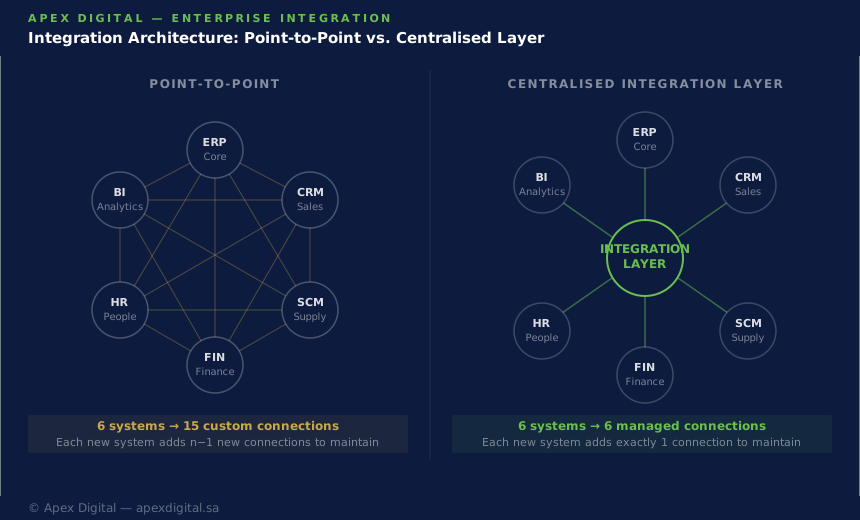
The mathematics of this model work against the organization as the system count grows. A three-system environment requires three connections to maintain full interoperability. A ten-system environment requires forty-five. Each connection is a maintenance liability: it must be updated when either system changes its schema, data format, or API contract, and a failure in any link can cascade across every connected system downstream. The architectural fragility is not a design flaw — it is a structural property of the model itself. Point-to-point integration at enterprise scale is an O(n²) problem: every additional system multiplies the maintenance burden of every system that already exists.
The visual below illustrates why this matters for architecture planning. The shift from a distributed point-to-point model to a centralized integration layer does not just reduce connection count — it changes the fundamental nature of the maintenance problem, from one that grows exponentially with system count to one that grows linearly.
Legacy ERP systems compound this challenge in a specific way. Because they were built on batch-processing architectures rather than real-time data exchange, any system connected to them inherits the same data latency — making continuous, cross-system visibility structurally impossible regardless of how good the surrounding applications are. Gartner identifies legacy ERP as the single most commonly cited obstacle to AI readiness among CIOs precisely because it sets a ceiling on data timeliness that no downstream AI system can overcome. The integration problem and the legacy modernisation problem are the same problem viewed from different angles.
04 - The Apex Framework
The Integration Maturity Model
Integration capability does not switch on. It develops through a recognisable sequence of organisational and architectural decisions, and most enterprises are somewhere in the middle of that sequence — past the reactive phase, short of the strategic one. The model below maps that progression across four stages, defined not by technology choice but by the relationship an organisation has with its own integration infrastructure.
The distinction that matters most is not between Stage 2 and Stage 3 — those are largely technical upgrades. It is between Stage 3 and Stage 4: the transition from treating integration as a capability that serves individual business functions to treating it as the architectural foundation for enterprise-wide intelligence, AI deployment, and real-time decision-making. Very few organisations have made that transition deliberately. Most arrive at Stage 3 through incremental investment and stop there, because the business case for Stage 4 requires a different kind of executive sponsorship than a technology upgrade can secure.
Why the sequence is non-negotiable
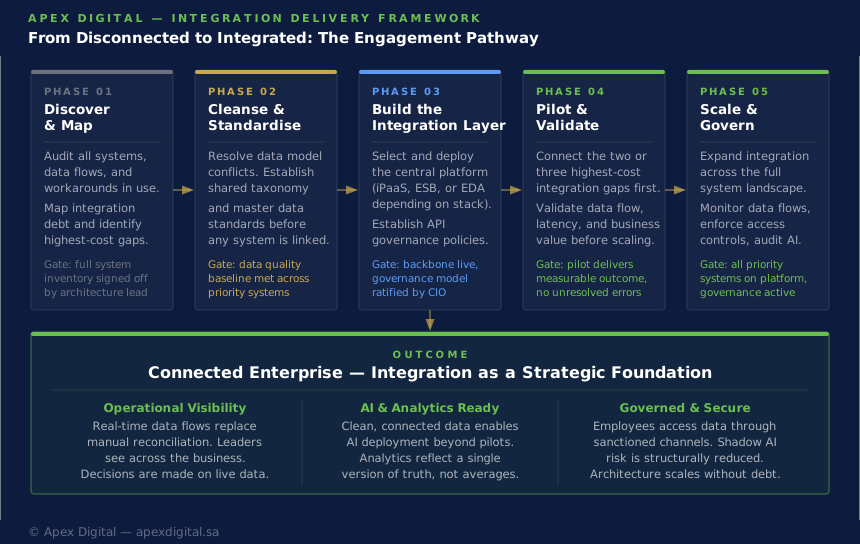
The most common failure mode in integration programmes is skipping Phase 2 — the data cleansing and standardisation work — and moving directly from audit to platform deployment. The reasoning is understandable: the platform is tangible, the budget is allocated, and the vendor is ready. But connecting systems that carry incompatible data models does not resolve the incompatibility. It industrialises it. Data that cannot be trusted at rest cannot be trusted in motion, and the integration layer becomes a high-speed pipe for the same inconsistencies that were causing problems before it was built.
Phase 4 — the pilot phase — is where most organisations also underinvest. The instinct is to connect everything at once, on the logic that partial integration creates a hybrid state that is harder to manage than the original disconnected one. In practice, the opposite is true. A two or three system pilot validates the architecture, surfaces edge cases in data mapping that were invisible at design time, and produces a business outcome that builds the internal confidence required to fund the full-scale rollout. Organisations that skip the pilot tend to discover those edge cases across thirty systems simultaneously, at a cost that is orders of magnitude higher to resolve.
The governance work in Phase 5 is not a closing formality. It is what determines whether the integration investment holds its value over time. Without active monitoring, API contract management, and access controls, the architecture degrades gradually — new point-to-point connections accumulate around it, ungoverned AI tools appear to fill data gaps that governance would have addressed, and the platform becomes one more system in an architecture that has not fundamentally changed. Phase 5 is where integration becomes a sustained capability rather than a completed project.
05 — The Governance Dimension
When Integration Gaps Become Security Liabilities
There is a dimension of the integration problem that does not show up in architecture reviews or digital transformation road maps, but is increasingly visible in breach reports: ungoverned AI adoption as a direct consequence of unresolved system fragmentation.
When employees cannot get the data or analytical capability they need through official channels — because the systems are disconnected, access is restricted, or the enterprise tooling is too slow — they find alternatives. This has always happened with software: the shadow IT wave of the 2010s, when employees adopted Dropbox, Slack, and personal cloud services faster than IT procurement could respond, established the pattern. What is different now is the payload. Shadow AI tools do not simply store files. They ingest source code, customer records, contracts, and strategic data, then transmit it to third-party model providers that sit entirely outside corporate visibility and control.
IBM’s 2025 Cost of a Data Breach Report, which for the first time studied AI-related security incidents systematically, found that one in five organisations experienced a breach attributable to shadow AI. Those incidents added an average of $670,000 to the breach cost compared to standard incidents — and 97% of the organisations that suffered AI-related breaches lacked the access controls that would have contained the exposure. The connection to integration is direct: where the enterprise architecture provides connected, governed, and functional data access, employees have no reason to route work through unsanctioned tools. Where it does not, they will — and the security exposure follows inevitably from the governance gap.
Integration governance is therefore not a technology concern in isolation. It is an organisational risk management function. Organisations that have not resolved their integration architecture are not just slower and less analytically capable than those that have — they are structurally more exposed to the security consequences of the workarounds their own employees are building around the gaps.
Where enterprise architecture provides connected, governed data access, employees have no reason to route work through unsanctioned tools. Where it does not, they will — and the security exposure is a predictable consequence of that gap.
06 — From Here
From Infrastructure to Competitive Capability
The organisations that will lead operationally over the next decade are not necessarily those with the most sophisticated AI models or the most modern individual systems. They are the ones with the most connected architectures — because connectivity is what determines whether investments in intelligence, automation, and real-time decision-making can actually reach the operational layer where they create value.
This reframing matters because it changes what integration investment is competing against in a capital allocation conversation. Against a technology procurement budget, integration is always a lower priority than the next system that does something visible. Against a strategic capability budget — one evaluated on the same terms as people capability, market capability, or innovation capability — integration looks different. It is the layer that determines whether all other investments compound or cancel each other out.
The transition from treating integration as a technical prerequisite to treating it as a strategic capability has practical implications for how organisations sequence decisions. Organisations that invest in integration readiness before committing to AI deployment, analytics platforms, or automation programmes will find those investments deliver significantly more of their projected value. Organisations that follow the conventional sequence — procure the AI, discover mid-deployment that the data infrastructure cannot support it, then attempt to retrofit the integration — incur both the original investment cost and the remediation cost, while delivering a fraction of the intended outcome on a significantly delayed timeline.
The empirical case for treating integration as a foundation rather than a follow-on is clear. Gartner’s prediction that 60% of AI projects will be abandoned for lack of AI-ready data is not a warning about AI strategy. It is a warning about integration strategy — or the absence of one. The organisations that avoid that outcome are not those that chose better AI tools. They are those that built the data connective tissue before they needed it.
Integration is not what you do after the systems are in place. It is the decision that determines whether the systems work together or against each other — and that decision, made early and made strategically, is one of the few architectural choices that compounds across every subsequent investment the organisation makes in data, analytics, and intelligence.
Explore Apex Digital's Expertise
Apex Digital is a transformation-focused consulting firm operating at the intersection of business, data and technology. We work across these domains to provide integrated solutions that support organizations from initial direction-setting through to full-scale execution.
Explore our full range of services to understand how we support organizations in delivering meaningful and sustained transformation